
If you would rather watch a video than read, it has all the same information.
What Are Sump Pumps?
Sump pumps are electric water pumps that take collected water below the surface of a basement floor and send it out of the house, usually into the yard.
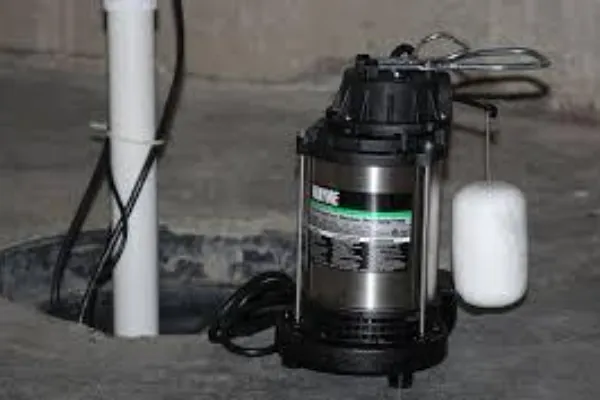
Most sump pumps are submersible, which means that they sit in a sump basin under water and automatically turn on when the water level reaches a certain height. After running for a few seconds or minutes, the pump should turn off again. Sometimes this automatic switching process breaks. You don't want to find out that your pump didn't turn on when it was needed most.
Many of you have sump pumps in your basement. We're going to show you how to test yours so that you can be confident it will turn on when you need it.
Understanding the Parts of the Sump Pump
You probably have a lid on the sump basin. A lot of them turn to unlock. Some screw down. Figure out how yours attaches and remove the lid so you can see into the basin.
The things you can see on top are a power cord, which usually plugs into the wall, and a discharge pipe. Some discharge pipes go under the floor and then up the wall and out. Others come up on top of the floor. Either way, there will be a discharge pipe somewhere.
You may have a black flexible hose. If you do, that's okay, but it will be a little less reliable. Check it for cracks and consider replacing it with solid PVC piping at some point. A good rule is to use 1 1/2-inch piping for most residential sump pumps.
If you have a flexible discharge hose, you probably have a connector that screws into the pump and a hose clamp that holds the hose to it. Make sure that clamp is tight. A loose clamp can cause the hose to pop off, preventing water from being pumped out at all.
There are two common switching methods. Some sump pumps use a floating switch with a switch inside that moves when you turn it up and down. If you listen carefully, you should be able to hear it click when you turn the switch upside down. As water fills the sump basin, the float rises and turns the sump pump on.
The other common method is a float attached to an arm that connects to the switch on top of the pump.
Keeping the Sump Basin Clean
If the basin is dirty, smells unpleasant, or contains insects, follow the pump manufacturer's cleaning instructions or call a plumber. Do not add pool chemicals or other cleaners that could damage the pump, create hazardous fumes, or discharge into the yard.
Is the Discharge Obstructed Outside?
Find the pipe where the sump pump discharges outside. Is it buried in the grass or restricted in some other way? Make sure you're getting good flow out of the discharge pipe. I've seen many that are completely buried underground, which greatly reduces the pump's effectiveness.
Basic Anatomy of a Sump Pump
The large bucket is called the sump basin. The most common type has tubes or pipes from around the perimeter of the basement drilled through the side of the basin.
When rainwater collects underneath the floor or footing of the house, it migrates through the gravel bed under the floor and into these perforated pipes. The water then runs through the pipes and dumps into the sump basin.
Another setup uses small holes drilled all around the side of the sump basin, with gravel surrounding it. When water collects in that gravel, it runs through the perforations and starts filling the basin.
Either way, the basin is a low point in your basement where water collects. The sump pump sits in the bottom and sends water out through the discharge pipe.
Most of the time you will see a check valve in the discharge pipe. A check valve permits one-way water flow. When the pump turns off, it prevents all the water in the discharge pipe from running back down and filling the sump basin again.
You might also see a slip coupling, which allows you to remove and service the sump pump. You can loosen the clamps and remove the assembly to repair or replace the pump.
For pumps with a switch arm and float, rising water lifts the float, raises the arm, and trips the switch. You can turn the sump pump on manually by raising the arm. That should start the pump and run the majority of the water out.
Test the Sump Pump
Try to trip your sump pump and start it manually. Make sure that it runs. We don't want to find out during a storm, or one morning when you discover two inches of water in your basement, that it isn't working.
If it runs, that tells us that the mechanics are working correctly, but what about the float? Floats can become saturated and less buoyant.
Check it another way by pouring water into the basin. Take a five-gallon bucket of water, dump it in, and see if the pump starts. If the pump turns on, you know the automatic switch works too. You can feel more confident that the next time it rains your sump pump will kick on and you won't be stuck with water in your basement.
Get out there and check your sump pump!